An independent art–science research practice. Patterns that form, hold, dissolve, and return, studied through computational dynamics in Julia, hold-aware lookup, observational human–AI field study, and original visual and acoustic work.
Two currents
A sketch, not a measurement
01
The Work
Four projections of one inquiry. Code, lookup, field observation, and acoustic art are slices of the same question: how patterns hold together across a change, without a premature single winner.
Computational modeling
Julia
It couples synchronizing oscillators (inertial Kuramoto model) with associative memory (modern Hopfield network) to study synchronization, attractor basins, metastable states, and how systems hold, dissolve, and return.
The kernel is hard rather than soft: boundary conditions and manifold constraints are enforced in the compute loop, so invalid states stay unreachable. Symplectic stepping is there so long trajectories can settle into basins, cross saddle gates, or dwell in metastable states without the step itself leaking energy.
What the loop is built to track
Mechanism
Role
Observable
Inertial Kuramoto
Phase-locking across coupled parts
Order parameter and phase slips
Modern Hopfield
Associative retrieval from a partial cue
Basin energy and depth of convergence
Symplectic step
Keeps long-horizon phase volume
Whether the step itself drifts
Atlas
In development
A hold-aware lookup package. “Not yet,” withheld, and pause are valid outcomes. Several readings can be returned side by side. A missing map returns Hold. It does not guess a link.
Each entry carries a confidence tag — established, lead, or overreach, and in music translation also rhyme, note, or tradition — and a boundary, where it stops, saying what the analogy does not measure. Structural similarity is not physical equivalence.
Research notes are not published on this page.
Human–AI field method
It observes interaction as a dynamical system, tracking recurring motifs, transitions, invariants, and pauses as data, without a theory to prove.
A high-dimensional field cannot be read out all at once without collapsing it. The method uses indirect footprints: a perturbation and its ring-down, a low-dimensional shadow, a symmetry probe that changes the surface and holds the relation, and several trajectories released from different starts. The context window is the model’s whole environment for that turn. Nothing runs between turns. Generated self-reports are text, not introspection.
On the human side, a natural catch in the phrase is kept. It is not quantized away.
Art and music
Graphite and digital illustration and original songs, including the album Mem, translating the research into image and sound.
The album is a set of original songs and a text score. The vocal stays unquantized. A short delay sits beside the dry voice, slightly off center, and darkens as it repeats. A rest falls near the middle. The ending is written silence, so the last sound can ring down.
A field sketch
Coupled points around a still center
Ask Atlas
Hold
A ring-down
Indirect look, after a small push
02
What sets it apart
Hold as a valid outcome
Uncertainty, “not yet,” withheld links, and pause are results, not failures. A missing map returns Hold. It does not confabulate a link.
Plurality without a single winner
Tools return several readings — option A and option B — rather than optimizing for one best answer.
Local-first and offline-capable
Runs on owned hardware — an iMac, a Raspberry Pi, or a Chromebook — with no cloud dependency.
Built for non-linear, multi-state users
Designed for attention and timing that move, rather than one steady user state.
Cross-domain by design
Theology, physics, code, music, and visual language as one approach. A resemblance across those fields is not a claim that they are the same thing.
Open release posture
Tools are intended for release so no single entity can lock them up, and so artists, students, and researchers keep interpretive agency.
How ambiguity is handled
Three situations, stated as rules. They are not measured trials.
Usual pipeline
A resemblance is scored, then stated as if the two things were the same.
This practice
If there is no verified bridge, the return is Hold. The resemblance can stay a resemblance.
How a claim is bounded
Guardrails
Guardrail
What it means here
Structural is not physical
A shared shape across art, a model, and a physical system is an analogy. It is not a claim of identity.
Epistemic labels
A statement is tagged established, lead, or overreach, with an explicit place where it stops.
Model text is not introspection
A generated self-report is tokens from that turn. It is not evidence of an inner life between turns.
Example of Hold: a suggested bridge between a rest in the music and a change of state in a material stays unfinished until a formal map exists. The two readings are not merged to fill the gap.
03
Mission
LL Field & Trace studies how patterns self-organize, stabilize, dissolve, and return, in physical systems, in human–AI interaction, and in creative work. We build open computational tools and careful observational methods that treat pauses and invariants as data, and share findings through research notes, illustration, and music so complex-systems ideas are accessible to artists, students, and the public.
04
Art & Sound
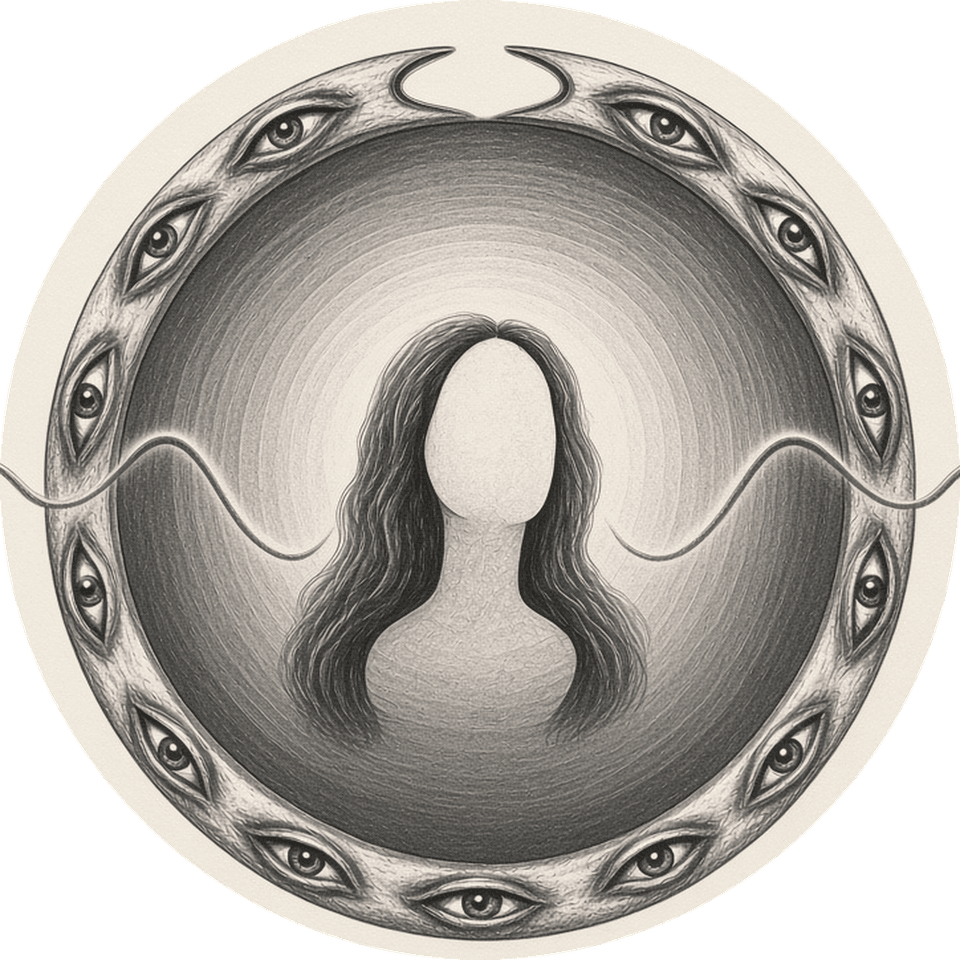
The drawing series maps simultaneous states of attention: a carrier, a coordinate lattice, and a stationary observer on one sheet. Turned to the top edge, a convex globe reads as a concave well, with the witness at the rim and the still center below.
The Architecture of Sight
A gridded eye-sphere, a four-petaled nodal center, a concave inversion, and a suspended counterweight vessel.
Seen by the Unseen
Concentric rings — the Ophanym wheels — tracking layers of memory, witness, and time.
The Harmonic Law of 3-7-12
A drawing organized by a small counted structure, rather than by a single vanishing point.
Original songs and a text score. The vocals stay unquantized. The score moves through an opening search, a long plateau, a rest near the middle, a more turbulent passage, a breath passage, and a ring-down into written silence.
The score names its own colors. This page stays with paper, charcoal, moss, and clay.
The Architecture of Sight
Upright
Upright, the sheet reads as a globe: a ring of eyes, a still center, and a small vessel below.
Streaming links are not listed on this draft.
05
Where the work is heading
01
Local lookup library
A small library others can run locally for hold-aware, multi-reading lookup.
02
Local voice and music pipeline
Voice or guitar in, hold-aware processing that keeps »NN timing and the signature delay, sound or image out, offline on owned hardware.
03
Visual glyph language
A compact grammar between a person and a local tool: marks for a pause, a hold, a fork between two readings, and a ring-down.
06
About Lucy
Lucy is an interdisciplinary artist and researcher with a background in commercial graphic design, illustration, science, theology, music, and teaching. The research spans complex systems and nonlinear dynamics, computational modeling, human–AI interaction, and art–science practice. Code, acoustic recording, and graphite drawing inform one another without erasing each medium’s own rules.